
Protective fabrics for eight high-risk sectors
Configured to the hazard profile of each sector, from molten metal and arc flash to flame and contact heat.
Eight sectors
Hazard intensity varies between roles within a sector, and blends should be refined by role.
Metal & foundry
Molten metal splash and contact heat resistance for furnace, casting, continuous casting and hot rolling positions, with abrasion resistance and mobility.
Power & grid
Arc protective fabrics graded by incident energy for live-line work, substation maintenance and switching, with optional antistatic and high visibility.
Oil & chemical
Flame retardant fabrics with antistatic and oil and water repellent performance for refining, upstream operations and storage, addressing flash fire and static ignition.
Fire & rescue
Inherent FR outer shells and comfort liners for firefighting, technical rescue and proximity work, with emphasis on integrity under heat flux and wash durability.
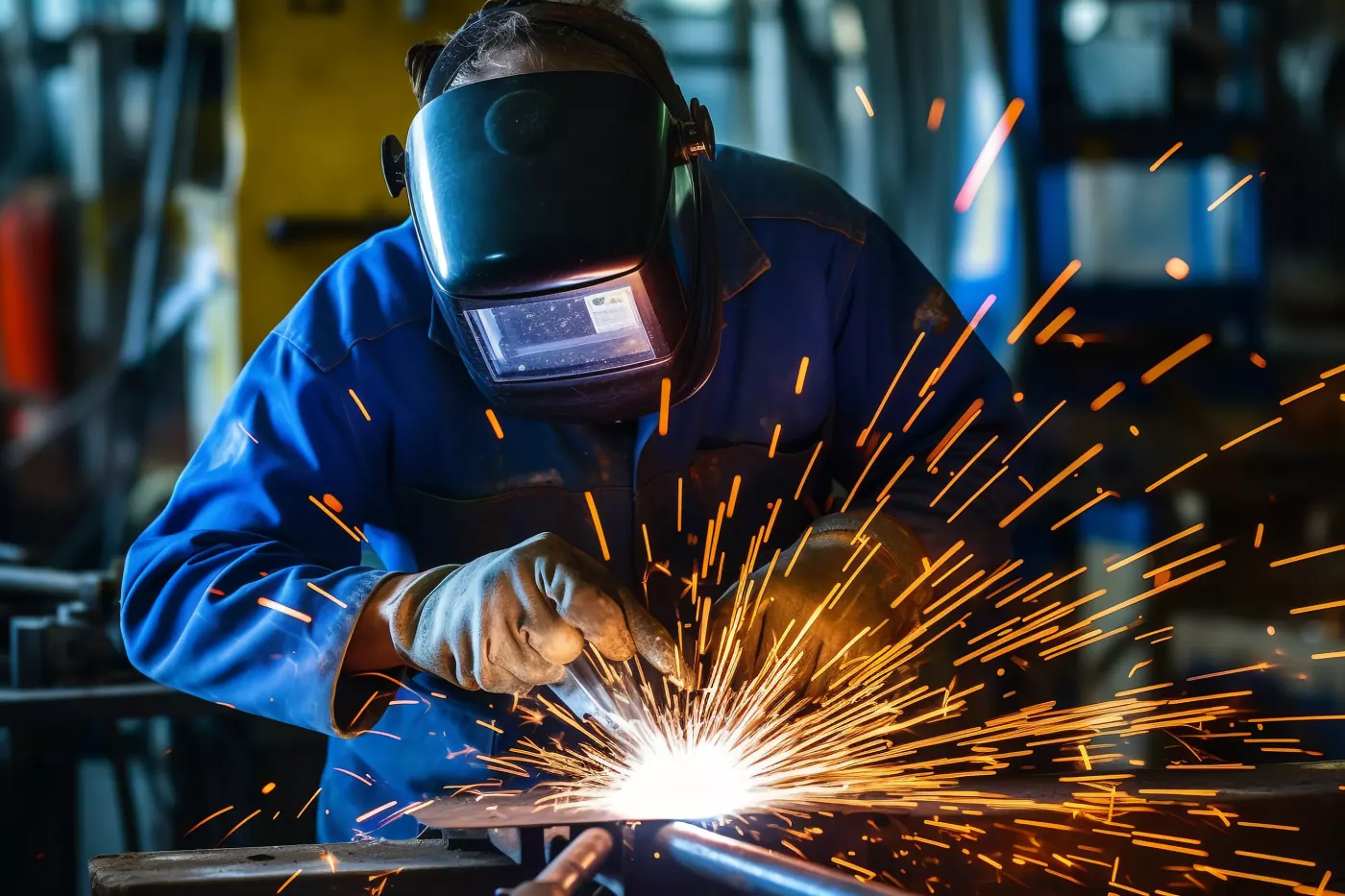
Welding & hot work
Spatter and burn-through resistance with mobility and service life. Class A and class B selected according to process heat.
Military & police
Duty and training garments with tear resistance, colour fastness and batch consistency, meeting uniform colour and insignia requirements.
Aviation & marine
Maintenance and cabin work with flame resistance plus antistatic performance, considering smoke toxicity, dimensional stability and dedicated flammability tests.
New energy & battery
Thermal runaway protection, energy storage insulation and vehicle fire barriers, largely custom, evaluated on finished assembly test results.
Metal & foundry: multiple hazards in combination
Furnace, ladle and casting positions typically combine molten metal splash, radiant heat from furnace openings, contact heat from hot castings, and sparks and weld spatter. Protection has to cover several hazards at once.
Four requirements on the fabric
- Penetration resistance — higher mass per unit area slows liquid metal through the structure
- No adhesion — carbonisation rather than melting, so fabric does not fuse to skin
- No entrapment — surface behaviour allows sparks and droplets to run off rather than lodge in the structure
- Durability — protection retained within agreed limits after repeated exposure and industrial laundering
This is why wool and aramid systems are long established in metalworking: wool carbonises without melting and sheds droplets readily, while aramid provides higher thermal stability and strength retention.
Why additional layers are not the answer
Adding layers raises weight and heat stress, reduces mobility, and increases the number of seams and openings that can trap material. The effective route is correct material selection rather than added thickness: a single-layer blend engineered to resist splash and limit heat transmission.
Power & grid: grade by incident energy
Arc protection is specified by numerical matching rather than a pass or fail threshold: prospective incident energy is determined from fault current and protective clearing time at the work location, and the fabric arc rating must exceed that value.
Three-step selection
- Step 1
- Establish fault current (kA) and protective clearing time (s) at the work location
- Step 2
- Calculate prospective incident energy (cal/cm²), or use the tables in NFPA 70E / DL/T 320
- Step 3
- Select a fabric whose arc rating (the lower of ATPV and EBT) exceeds that energy
Supporting requirements
- Antistatic
- Substation and live-line work generally also requires static dissipation
- High visibility
- Repair and road works require visibility performance to be combined
- Integrity
- Breakopen (EBT) can precede burn injury and should be assessed together
Oil & chemical: flame resistance and antistatic together
In petrochemical environments these are not two optional features but a pair of conditions that must both hold: static discharge is the ignition source, and once a flash fire occurs the fabric must self-extinguish quickly without melting.
Three process choices affecting long-term performance
- Woven conductive yarn vs antistatic finish — woven yarn is durable, finishes decline with washing; woven yarn is preferred for petrochemical use
- Oil and water repellency trade-off — repellent finishes reduce combustible soiling but also reduce moisture absorption, which matters in hot climates
- Inherent vs treated — petrochemical garments are usually industrially laundered, where inherent FR holds performance more consistently over repeated washing
Fire & rescue: assessed at garment level
Firefighting clothing is a system: outer shell, moisture barrier, thermal liner and comfort layer, together with sewing thread, reflective tape, closures and construction. Failure of any layer or component reduces assembly performance, so assessment is made at garment level rather than on a single fabric.
Outer shell
SHELL- Requirement
- Inherent FR, high strength, tear resistance, no loss after washing
- Models
- TK-A100 · TK-A300
Comfort layer
LINER- Requirement
- Skin contact comfort, moisture absorption, no cling when wet, FR
- Models
- TK-A400 · TK-V100
Thermal and special
SPECIAL- Requirement
- Radiant heat reflection, burn-through resistance
- Models
- TK-L100 · TK-S100
Other sectors
Welding & hot work
Class A (higher protection) and class B are selected according to process heat. Spatter and burn-through resistance must not come at the cost of mobility, since kneeling, squatting and overhead welding determine practical usability.
Higher weight improves burn-through resistance but reduces mobility and comfort.
Military & police
Duty and training clothing prioritises tear resistance, colour fastness, batch consistency and concealment. Flame retardant requirements follow the task profile and must meet uniform colour and insignia specifications.
Colour and pattern can be matched to shade cards; small-lot colour approval is recommended first.
Aviation & marine
Maintenance, cabin work and crew clothing. Beyond flame resistance, smoke toxicity, antistatic behaviour and dimensional stability apply; aircraft interior materials follow dedicated flammability tests.
Aviation approvals usually apply to a specific material grade; a change of grade requires retesting.
New energy & battery
Thermal runaway protection, energy storage insulation and vehicle fire barriers. Largely custom work, centred on short-term high-temperature resistance, insulation and structural integrity.
Standards in this field continue to develop; finished assembly test results are the appropriate basis.
Graded supply in practice
Grid maintenance clothing is graded by protection level: one client, several fabric specifications.
Grid construction and maintenance clothing: L1 – L4
Graded by protection level across L1, L2, L3, L4 and emergency response clothing, with summer, spring/autumn and winter systems, meeting combined requirements for antistatic, arc flash, rain and cold protection, and UV resistance.
The technical difficulty lies less in any single fabric than in consistency between grades: garments worn by the same crew across seasons and roles must remain consistent in appearance and washing regime, while protection levels stay clearly differentiated. This is achieved by graded blending within a single fibre system.
- Grades
- L1 / L2 / L3 / L4 + emergency response
- Seasonal systems
- Summer · spring/autumn · winter
- Performance
- Antistatic · arc flash · rain and cold · UV
- L1
- Cotton · nylon · antistatic composite fibre
- L2
- Modacrylic · cotton · antistatic composite fibre
- L3 / L4
- Aramid · modacrylic · new regenerated fibres
Case content is compiled from technical configurations of existing supply. Models, quantities and test conclusions for specific projects are subject to the corresponding contract and batch documentation.
Other working environments,
configured by hazard type.
Send a description of the working environment and hazard type, and we will return model recommendations and a sampling schedule.