
Between flame and skin,
there is only fibre
TAIKELUN is the flame retardant protective fabric brand of Zhejiang Taihui Textile Co., Ltd. Fabrics are configured by workplace hazard — flame, molten metal, electric arc and contact heat — using the fibre systems suited to each, with custom blends available per project.
Identify the hazard, then specify the fabric
The same flame resistance requirement points to molten metal penetration in metalworking, incident energy in power distribution, and static ignition in petrochemical plants.
Own production base and laboratory
Fibre selection, weaving, FR finishing and testing are carried out within our production and quality management system. Process parameters are traceable and reproducible.
Production to order
Fabrics are blended and woven against confirmed orders. End use and performance requirements are established before production starts, rather than adapted from stock.
Industries and applications
Metal & foundry
Molten metal splash, furnace radiant heat and contact heat with hot castings occur together. Requires penetration resistance, no adhesion and no entrapment.
Power & grid
Graded by incident energy at the work location rather than by flame resistance rating. Key parameters are ATPV and EBT.
Oil & chemical
Flame resistance and antistatic performance must be satisfied together: one limits combustion after ignition, the other removes the ignition source.
Fire & rescue
Assessed at garment level rather than on a single fabric layer. Outer shell, thermal liner, comfort layer and components jointly determine performance.
Welding & hot work
Spatter resistance and mobility pull against each other. Higher weight improves burn-through resistance but restricts movement.
Military & police
Tear resistance, colour fastness and batch consistency take priority, together with the colour and insignia requirements of the relevant uniform specification.
Aviation & marine
Beyond flame resistance, smoke toxicity, antistatic behaviour and dimensional stability apply. Aircraft interior materials follow separate flammability tests.
New energy & battery
Thermal runaway protection and energy storage insulation. Largely custom work, evaluated on finished assembly test results.
Production and quality
behind the brand
TAIKELUN operates from the production base of Zhejiang Taihui Textile Co., Ltd. in Shaoxing, Keqiao — covering raw material management, spinning and weaving, special finishing, testing, sampling and warehousing to form a complete chain from fibre to finished fabric.
Weaving
Woven and knitted constructions; plain, twill, broken twill, satin and ripstop designed to strength and drape requirements.
FR finishing
Flame retardant, antistatic, water and oil repellent, UV-resistant, pre-shrunk and soft finishes combined by application.
Laboratory
Three-stage testing of raw materials, in-process samples and finished goods, ahead of release.
Sampling and warehousing
Rapid swatch and garment sampling; Yangtze River Delta location near Ningbo-Zhoushan Port and Hangzhou airport.
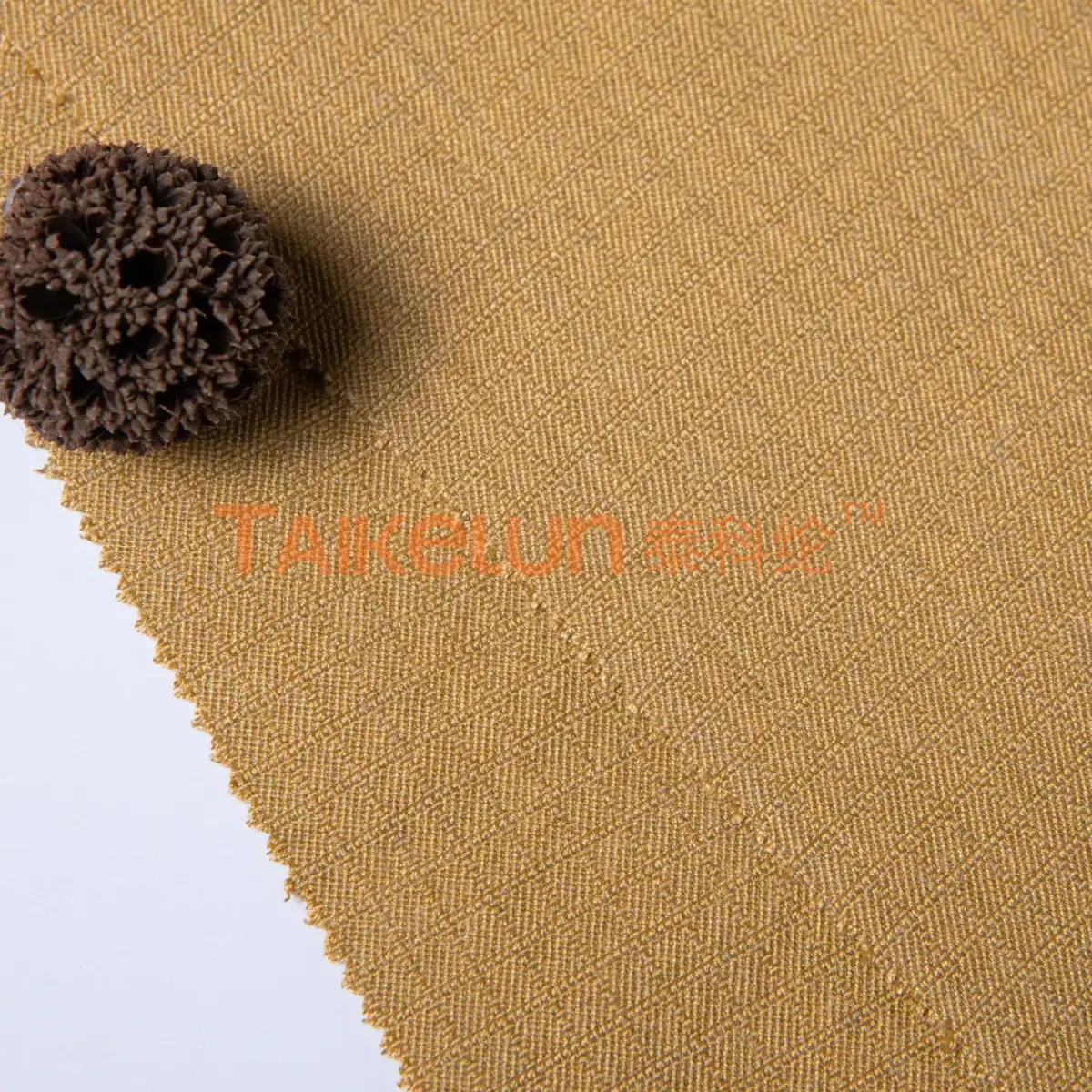
Production to order
Made-to-order production directly affects lead time, minimum order quantity and delivery scheduling.
"Fabric is produced only against confirmed requirements, so that stock positions never determine the technical recommendation."
TAIKELUN / Production principleCustom blends suit the application more closely than standard ranges, and therefore require parameters to be settled early in the project.
Standards as the common language
Protective fabrics are evaluated against standards. Test items and pass criteria are confirmed at order stage.
| Application | China GB / XF | Europe EN / ISO | US NFPA / ASTM |
|---|---|---|---|
| Firefighting | XF 10-2014 | EN 469 | NFPA 1971 |
| Flame retardant workwear | GB 8965.1 | EN ISO 11612 | NFPA 2112 |
| Molten metal splash | GB 8965.3 | EN ISO 11612 (D/E) | ASTM F955 |
| Arc flash | GB 8965.4 / DL/T 320 | IEC 61482 | NFPA 70E |
| Welding and hot work | GB 8965.2 | EN ISO 11611 | NFPA 2112 |
| Antistatic | GB 12014 | EN 1149-5 | NFPA 2112 |
| High visibility | GB 20653 | EN ISO 20471 | ANSI/ISEA 107 |
Table indicates referenced standards. Specific test items, pass criteria and test reports are subject to contract agreement and to the measured results of the corresponding batch.
One client, several
graded specifications
Protection level should match work risk. The difficulty in graded supply lies in keeping appearance, handle and washing regimes consistent across levels.
Grid construction and maintenance clothing: L1 – L4
Graded by protection level across L1, L2, L3, L4 and emergency response clothing, with summer, spring/autumn and winter garment systems, meeting combined requirements for antistatic, arc flash, rain and cold protection, and UV resistance.
The technical difficulty lies less in any single fabric than in consistency between grades: garments worn by the same crew across seasons and roles must remain consistent in appearance and washing regime, while protection levels stay clearly differentiated. This is achieved by graded blending within a single fibre system.
- Grades
- L1 / L2 / L3 / L4 + emergency response
- Seasonal systems
- Summer · spring/autumn · winter
- Performance
- Antistatic · arc flash · rain and cold · UV
- L3 / L4
- Aramid · modacrylic · new regenerated fibres
Case content is compiled from technical configurations of existing supply. Models, quantities and test conclusions for specific projects are subject to the corresponding contract and batch documentation.
Fabric is where
the protection system starts
A protective garment passes through sampling, production, testing, garment making, laundering and replacement. Technical support at each stage affects final performance.
Technical selection
Blend recommendations based on hazard profile and target standard, with the reasoning behind the fibre system and weight.
Sampling
A4 swatches and shade cards; small-lot garment samples to verify handle, dimensions and process consistency.
Testing and documentation
Testing to agreed standards, with model-level and batch-level conclusions; technical documents are issued under our company name.
Laundering and care
Washing and drying guidance by fabric system, together with expected performance change over repeated washing.
Send the application and
receive a verifiable specification.
Hazard type, target standard, laundering method, quantity and delivery date enable us to propose a fibre system and sampling schedule.